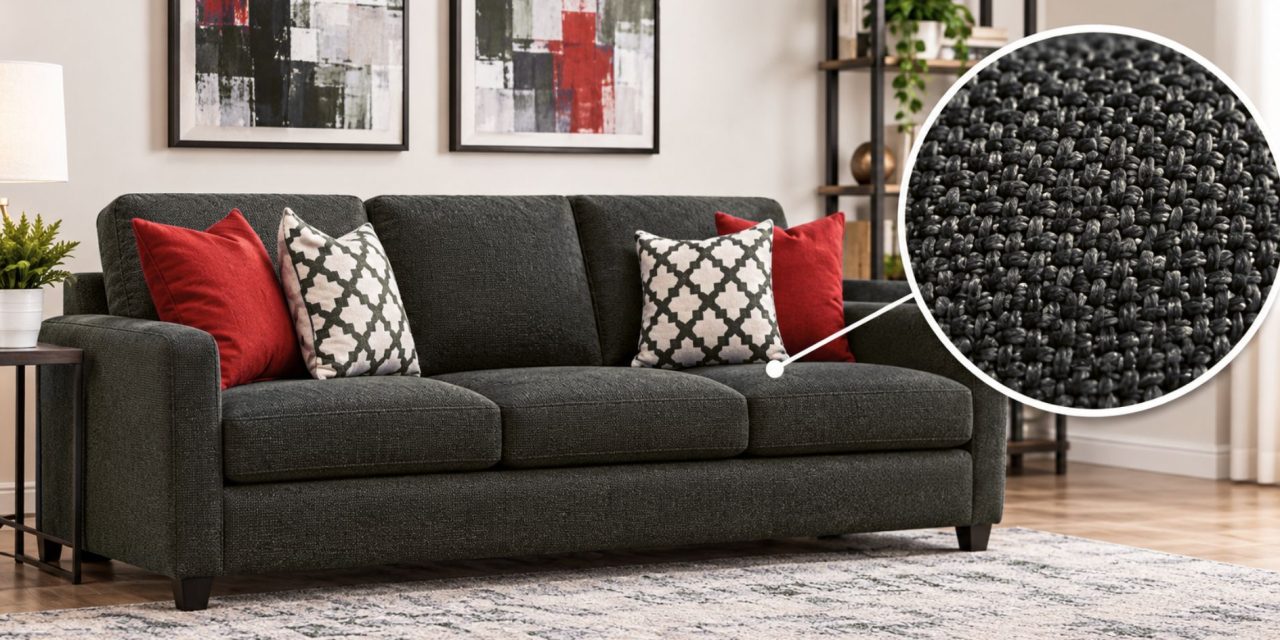
Ever wondered why some sofa fabrics withstand years of everyday use while others show wear surprisingly quickly? One clue is the fabric’s rub count, also known as its upholstery abrasion rating.
This rating measures how well fabric resists repeated friction. But what do the numbers actually mean, and how should they influence your upholstery choices? Let’s look at the two main testing methods and how to interpret their results.
What Is a Rub Count and Why Does It Matter?
A rub count measures how many friction cycles an upholstery fabric can withstand during a controlled abrasion test before showing a specified level of wear. Think of it as a fabric stress test. It tells you how well a textile resists surface rubbing, not how long the entire sofa will last.
Sometimes called an upholstery abrasion rating, this measurement helps you assess whether a fabric is suitable for its intended use. A sofa in a busy family room experiences more repeated contact than an occasional accent chair. Comparing abrasion ratings can help you identify fabrics better suited to those different demands.
Here’s what a rub count helps you understand:
- Abrasion resistance, or how well the fabric surface withstands repeated friction.
- How the textile responds to rubbing that can damage fibers or yarns.
- Whether a fabric meets a particular abrasion performance benchmark for residential or commercial upholstery.
However, a rub count doesn’t tell the whole story of fabric durability. It doesn’t measure how well a fabric handles spills, sunlight, stretching, or everyday grime. Pilling and colorfastness also require separate assessments.
These qualities depend on other factors, including fiber content, weave, and finishing treatments. For example, a fabric may have an impressive abrasion rating but still stain easily or fade when exposed to direct sunlight. Another may resist wear but feel uncomfortable against your skin.
So when you see a number like 30,000 double rubs on a swatch tag, treat it as one useful signal among several. It’s a strong starting point when comparing upholstery fabrics for different levels of use. Just don’t treat it as a guarantee of how long your furniture will last.
How the Martindale and Wyzenbeek Tests Work
The Martindale and Wyzenbeek tests are two widely used methods for measuring fabric abrasion resistance. However, they work in noticeably different ways.
The Martindale test rubs fabric in a multidirectional, figure-eight pattern. The standard abrasive is typically a worsted wool fabric. Results are recorded in Martindale cycles, with the test continuing until the specified wear or breakdown point is reached. A fabric might be rated at 20,000 Martindale cycles or more.
The Wyzenbeek test moves fabric back and forth in a straight line against an abrasive surface. The rubbing material is commonly cotton duck, although wire screen may also be specified. Results are recorded in double rubs. One complete back-and-forth movement counts as one double rub. A rating of 15,000 double rubs is a commonly cited benchmark for general contract upholstery.
Each test follows its own standard:
- ASTM D4157 covers the Wyzenbeek method.
- ASTM D4966 and ISO 12947 cover Martindale testing.
Here’s the catch: results from the two tests are not directly comparable. A 20,000 Martindale cycle rating and a 20,000 double rub rating don’t represent the same amount of wear. The movements, abrasive materials, and test procedures differ.
That’s why you should always compare like with like. If one swatch lists Martindale cycles and another lists double rubs, you can’t rank them side by side. Check the test method first, then compare the results.
| Feature | Martindale | Wyzenbeek |
| Motion | Multidirectional figure-eight pattern | Back and forth |
| Abrasive | Typically worsted wool fabric | Cotton duck or wire screen |
| Unit | Cycles | Double rubs |
| Standard | ASTM D4966, ISO 12947 | ASTM D4157 |
Decoding the Numbers: Light, Medium, and Heavy-Duty Ranges
Once you know which test was used, the next step is understanding what the numbers mean for everyday use. There are general benchmarks, but classifications can vary between manufacturers and industry guidelines.
For Wyzenbeek double rubs, commonly used upholstery benchmarks include:
- Below 15,000 double rubs: Generally considered below the commonly cited threshold for general contract upholstery. It may suit some decorative or occasional-use applications, depending on the fabric.
- Around 15,000 double rubs: A commonly cited benchmark for general contract upholstery and lower-traffic applications.
- Around 30,000 double rubs: A benchmark associated with heavy-duty upholstery and higher-traffic use.
For Martindale cycles, commonly referenced benchmarks include:
- Below 20,000 cycles: May suit some lighter-use applications, depending on the fabric and manufacturer’s guidance.
- Around 20,000 cycles: A commonly cited benchmark for general contract upholstery.
- Around 40,000 cycles: A benchmark associated with heavy-duty upholstery and higher-traffic settings.
These are useful reference points, not universal rules. For example, the Association for Contract Textiles (ACT) identifies 15,000 Wyzenbeek double rubs and 20,000 Martindale cycles for low-traffic private spaces. Its high-traffic benchmarks are 30,000 double rubs and 40,000 Martindale cycles. Always check the specification sheet and the intended application rather than relying on a marketing label.
Match the rating to the room. A reading nook chair that gets occasional use may not need the same abrasion rating as a family sofa. A sofa in a home with children, pets, and daily movie nights will likely benefit from more robust upholstery.
When comparing fabrics, don’t automatically assume that the highest number is the best choice. Higher abrasion results don’t necessarily translate into a longer furniture lifespan. Fiber content, weave, construction, maintenance, and the way people use the furniture all matter. A fabric’s suitability comes from how well its overall properties match your needs.
The Bottom Line: Look Beyond the Number
A fabric’s rub count gives you a useful indication of how well it withstands repeated friction. However, it shouldn’t be the only factor guiding your upholstery choice. The test method, fabric composition, intended use, and other performance qualities all contribute to how well upholstery performs over time.
Want a sofa that still looks inviting after years of family movie nights, weekend lounging, and everyday use? Discover more ways to choose furniture and fabrics that combine lasting appeal with everyday comfort at You’re In Style.